Electro-optical modulation of terahertz beam by drifting space-charge domains in n-GaN epilayers

The research article by Roman B. Balagula, Liudvikas Subačius, Paweł Prystawko, and Irmantas Kašalynas is published in Journal of Applied Physics, AIP Publishing. The work entitled “Electro-optical modulation of terahertz beam by drifting space-charge domains in n-GaN epilayers” investigates the transmission modulation of THz field in GaN semiconductor as a response to space-charge domains under near-to-breakdown electrical field conditions.
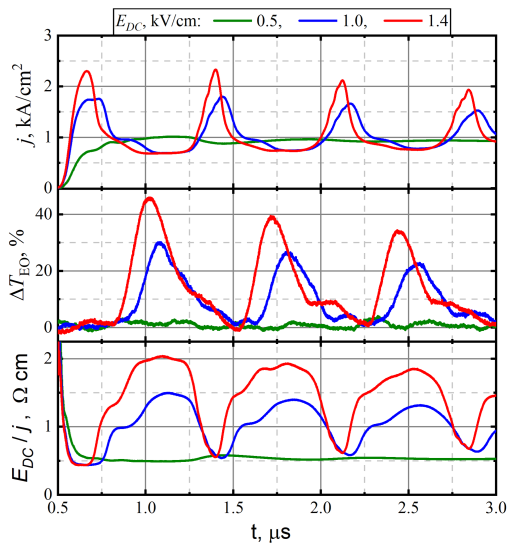
Traces of charge current density j, the electro-optic modulation of THz beam transmission ΔTeo, and the sample specific resistance, Edc/j, found as a ratio between measurements of applied electric field and current density traces.

The open access research article is available through https://doi.org/10.1063/5.0152661

The work was supported by the Research Council of Lithuania through the “Hybrid plasmonic components for THz range (T-HP)” Project (Grant No. DOTSUT-184) funded by the European Regional Development Fund according to the supported activity “Research Projects Implemented by World-class Researcher Groups” under the Measure No. 01.2.2-LMT-K-718-03-0096. The work at Warsaw was supported by the National Center for Research and Development (Grant No. TECHMATSTRATEG-III/0003/2019/EnerGaN).
Narrowband Thermal Terahertz Emission of Ti/Au Metasurface on Homoepitaxial GaAs

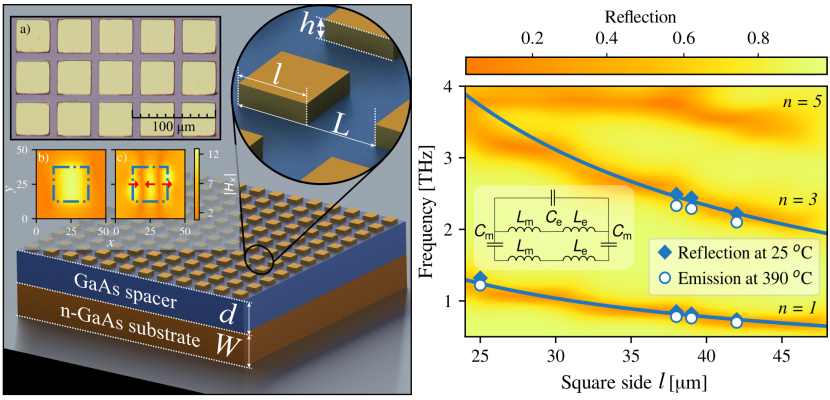
New work by I. Grigelionis et al. was published in the scientific journal Sensors from MDPI publisher. Authors report on the experimental evidence of thermal terahertz emission tailored by magnetic polariton excitations in entirely GaAs-based structures equipped with metasurfaces. Thermal emission was measured at 390 C temperature in the range from 0.7 THz to 1.3 THz, depending on the size of the square metacells.

The magnetic polariton resonance quality factors obtained at elevated temperatures (Q ~ 3.3 to 5.2) are very similar to those of MIM structures as well as to 2D plasmon resonance quality at cryogenic temperatures.

The open access paper can be reached through https://doi.org/10.3390/s23104600

This research has received funding from the Research Council of Lithuania (LMTLT), agreement No. S-MIP-22-76.